Characteristic Accountability in AS9102: How to Balloon a Drawing So Form 3 Maps One to One
The fastest way to get an AS9102 First Article Inspection package bounced is not a measurement out of tolerance. A nonconformance with a disposition is a normal outcome an aerospace SQE expects to see. The fastest way to get the whole binder rejected on the first read is a characteristic accountability gap: a dimension on the drawing that has no balloon, a balloon that has no Form 3 line, a note that imposes a requirement and was never numbered, or a Form 3 with 47 lines against a drawing that carries 61 characteristics.
Characteristic accountability is the discipline of proving that every requirement on the design record has been identified, uniquely numbered, and verified. It is the spine of the entire FAI. Form 3 is literally titled "Characteristic Accountability, Verification, and Compatibility Evaluation," and the first word in that title is the one teams skip past. This guide covers what a characteristic is under AS9102 Rev C, how to balloon a drawing so the count is defensible, how GD&T and general notes get accounted, and how to keep the mapping intact through a revision.
What Characteristic Accountability Actually Requires
AS9102 Rev C, published by the IAQG and released by SAE on 2023-06-23, requires that all design characteristics are identified and accounted for on the FAI report. "All" is the operative word. A design characteristic is any dimensional, visual, functional, material, or process requirement defined on the design record that can be measured, tested, or verified. The accountability requirement is that each of those gets a unique characteristic number, and that number ties a specific location on the drawing to a specific line on Form 3.
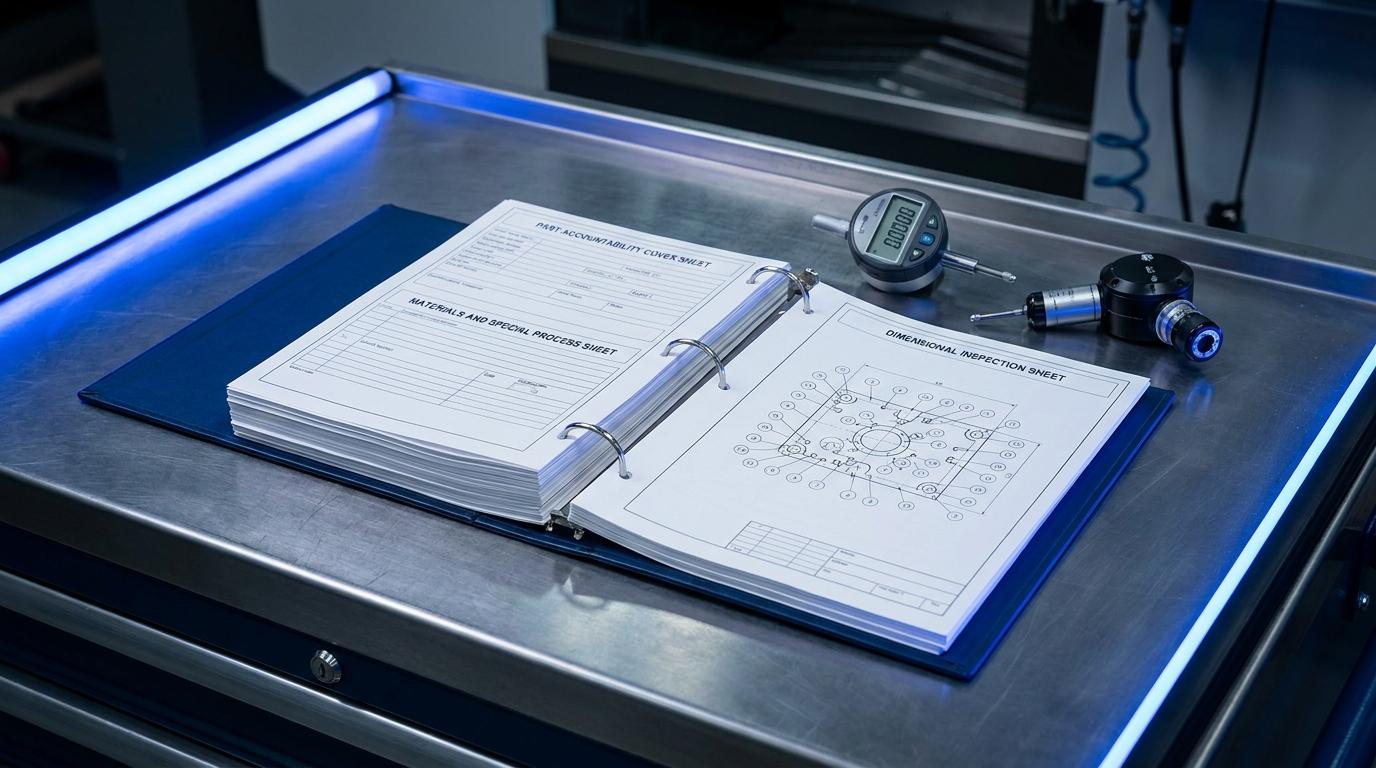
The mechanism for that mapping is ballooning. You take a copy of the released drawing, you circle each characteristic, and you write a unique sequential number inside or next to the circle. That marked-up copy, the "bubble drawing" or "ballooned print," becomes a required attachment to the FAI package. Every balloon number on the print has exactly one matching row on Form 3, and every row on Form 3 points back to exactly one balloon. One to one, in both directions. There is no such thing as a Form 3 line that covers "balloons 12 through 15." There is no such thing as a balloon that the inspector decided not to report.
When an aerospace SQE opens your package, the very first thing a careful reviewer does is reconcile the count. They look at the highest balloon number on the print, they count the rows on Form 3, and the two numbers had better match. If your drawing has a general note that says "break all sharp edges .005 to .015" and that note has no balloon, the reviewer now distrusts the entire accountability pass, because if you missed that one, what else did you miss.
What Counts as a Characteristic
This is where the judgment lives, and where two competent inspectors will balloon the same drawing and arrive at counts that differ by ten. The goal is not a "right" number. The goal is that every requirement is captured exactly once and nothing is double counted or dropped. Here is what has to get a balloon.
Every dimension with a tolerance. Linear dimensions, angular dimensions, diameters, radii, chamfers, depths. Each toleranced dimension is one characteristic. A diameter called out with a position tolerance is two characteristics: the size dimension is one, the position feature control frame is another.
Every feature control frame. GD&T is the area teams undercount most. A single feature control frame is one characteristic. If a hole carries a position callout and the same surface carries a separate flatness callout, that is two characteristics, not one. Datum features that are referenced get accounted as well. The standard practice is to balloon each datum feature symbol and each feature control frame as its own line, because each one is independently verifiable and independently dispositioned if it fails.
Notes that impose a requirement. General notes and flag notes are characteristics when they define something verifiable. "Material: Ti-6Al-4V per AMS 4911" is a characteristic. "Passivate per AMS 2700, Method 1" is a characteristic. "Surface finish 63 microinch Ra unless otherwise specified" is a characteristic, and if it is a general note it covers every surface that lacks a local callout. "Deburr all edges" is a characteristic. The mistake is treating the notes block as context rather than as requirements. Read every note and ask whether an inspector could verify it. If yes, it gets a balloon.
Title block and general tolerances. When a feature is dimensioned without a local tolerance, the title block tolerance applies. Those features still need accountability. A common, accepted approach is to balloon the general tolerance note once and then ensure every undimensioned-tolerance feature is still measured and reported, but practices vary by customer flow-down, so confirm how your customer wants general-tolerance features handled before you balloon a 200-feature machined housing.
Surface finish callouts. Ra, lay direction, and machining allowance are requirements. A surface finish symbol on a specific face is its own characteristic. We covered why these belong on Form 3 rather than buried in a notes column in Surface Finish Per Balloon.
What does not get a balloon: reference dimensions, marked REF or shown in parentheses, are not characteristics because they are not independently controlled. Basic dimensions, shown in a box, are theoretically exact and are not inspected directly; they are accounted for through the geometric tolerance that references them, so the position or profile feature control frame carries the accountability, not the basic dimension itself. Stock and customer-furnished information that is not a delivered requirement also stays off the count.
The Form 3 Columns That Carry the Mapping
Form 3 under Rev C is structured so that each row is self-contained proof for one characteristic. The columns that do the accountability work:
| Column | What it carries |
|---|---|
| Characteristic Number | The unique balloon number. Sequential, no gaps, no duplicates. |
| Reference Location | The drawing zone and sheet where the balloon lives, so the reviewer can find it fast on a multi-sheet print. |
| Characteristic Designator | The flag for key characteristics, critical items, or other special designators the design organization assigned. Blank if the characteristic is standard. |
| Requirement | The nominal value and tolerance exactly as stated on the design record, including the unit and the limit. |
| Results | The actual measured value, recorded as a variable where possible, not a pass or fail checkmark. |
| Designed / Qualified Tooling | Used when a tool or gage is the design-authorized means of verification. |
| Nonconformance Number | Populated only when the result falls outside the requirement, tying the line to the nonconformance record and its disposition. |
The Characteristic Designator column is the one with the highest audit weight. If the design organization flagged a dimension as a key characteristic, that flag has to propagate from the drawing, into the balloon, onto Form 3, and onward into the control plan and the SPC plan. A KC that is correctly measured on Form 3 but never flagged in the Characteristic Designator column is an accountability failure, because the downstream traceability to the control plan is now broken. The reviewer reads that column to confirm your KC flow-down is intact.
Record results as variable data. "Pass" tells the SQE nothing about where you sit in the tolerance band. A position result reported as 0.18 against a 0.25 requirement tells them the process has margin. A position result reported as 0.24 against 0.25 tells them you are about to have a problem on the second lot. The number is the evidence; the checkmark is not.
How to Balloon Without Losing the Count
A few habits keep the one to one mapping intact on a real drawing rather than a textbook example.
Balloon by zone, top left to bottom right, sheet by sheet. A predictable traversal order means that when the count is off you can re-walk the drawing and find the gap quickly, rather than hunting randomly. Record the zone in the Reference Location column as you go.
One requirement per balloon, always. When a callout combines a size and a geometric control, split it. When a slot has a width and a length and a position, that is three balloons. Combining requirements under one number is the single most common reason a Form 3 count comes out lower than the drawing's true characteristic count, and it hides nonconformances because the line can only carry one result.
Balloon the notes block deliberately. Walk the general notes and flag notes as a separate pass, after the dimensional pass, so you do not skip them in the rush to get the geometry numbered. Each verifiable note gets its own balloon and its own Form 3 line with the requirement transcribed.
Reconcile before you sign. Before the package goes out, count the balloons on the print, count the rows on Form 3, and confirm they are equal with no gaps in the numbering sequence. Then spot check five random balloons against their Form 3 lines to confirm the requirement was transcribed correctly. This ten minute reconciliation is the single highest-leverage check in the whole FAI.
The manual version of this work is slow and error prone on a dense aerospace print, which is exactly why drawing feature extraction is the part of the FAI that purpose-built tooling helps most. Blueprint Intelligence reads dimensions, tolerances, GD&T feature control frames, weld symbols, and surface finish callouts directly off a PDF or image of the drawing, so the characteristic list and the balloon numbering come from the print itself rather than from someone retyping 60 callouts into a spreadsheet at 6 pm. The accountability discipline still belongs to the engineer, but the transcription errors that break the one to one mapping are where automation earns its keep.
Keeping Accountability Intact Through a Revision
The mapping is not a one-time event. When the drawing goes from Rev D to Rev E, the design organization changed something, and your accountability has to reflect exactly what changed and nothing else. A partial FAI re-accomplishment, the scope of which we covered in the parent guide on how Form 1, Form 2, and Form 3 fit together, re-balloons only the affected characteristics on Form 3 while Form 1 is re-signed in full.
The trap is balloon renumbering. If Rev E adds a characteristic and you renumber the entire print to keep the sequence clean, you have just severed the traceability between the original FAI and the delta, and a reviewer can no longer tell what the change actually touched. The accepted practice is to preserve the existing balloon numbers and append the new characteristics at the end of the sequence, so balloon 47 still means on Rev E what it meant on Rev D, and the new feature is balloon 62. Stable numbering across revisions is what lets a customer audit the change history of a part years later.
This is also where characteristic accountability connects to the rest of the quality system. On programs that require both an AS9102 FAI and a PPAP submission, Form 3 maps directly to the dimensional results element of the PPAP package, which we walk through in What is PPAP. The same ballooned print and the same characteristic numbers feed both deliverables, so building accountability correctly once pays off in two submissions. And the KC designators that flow from Form 3 into the control plan are exactly the items an AS9100D auditor traces during a process audit, which is why the AS9100 internal audit checklist treats characteristic-to-control-plan traceability as a core line item.
The Reviewer's Mental Model
If you want to build a package that clears on the first read, think the way the SQE on the other end thinks. They are not trying to catch you. They are trying to answer one question: can I trust that this supplier verified every requirement on my design record. Characteristic accountability is how you answer that question before they ask it.
A clean count, a ballooned print they can navigate by zone, variable results instead of checkmarks, KC flags that propagate, and a numbering scheme that survived the last revision: those five things tell the reviewer that your accountability process is real and repeatable. The measurements can have a nonconformance and the package still clears, because a dispositioned nonconformance is honest. What does not clear is a package where the reviewer cannot tell whether you accounted for everything. Get the accountability right and the FAI stops being the thing that holds up your first delivery.
Characteristic accountability is the kind of work that rewards a system over a hero. QualityEngineer.ai pulls the characteristic list straight off the drawing, holds the balloon-to-Form-3 mapping for you, and carries the KC designators into the control plan, so the one to one discipline this article describes is enforced by the tool instead of by the inspector's memory at the end of a long day.
Related Reading
- AS9102 First Article Inspection: How Form 1, Form 2, and Form 3 Fit Together Under Rev C for the full three-form structure that surrounds characteristic accountability
- Surface Finish Per Balloon for why Ra, lay, and machining allowance each need their own characteristic
- AS9100 Internal Audit Checklist for how characteristic-to-control-plan traceability gets audited
- What is PPAP? for how Form 3 maps to the PPAP dimensional results element on dual-submission programs