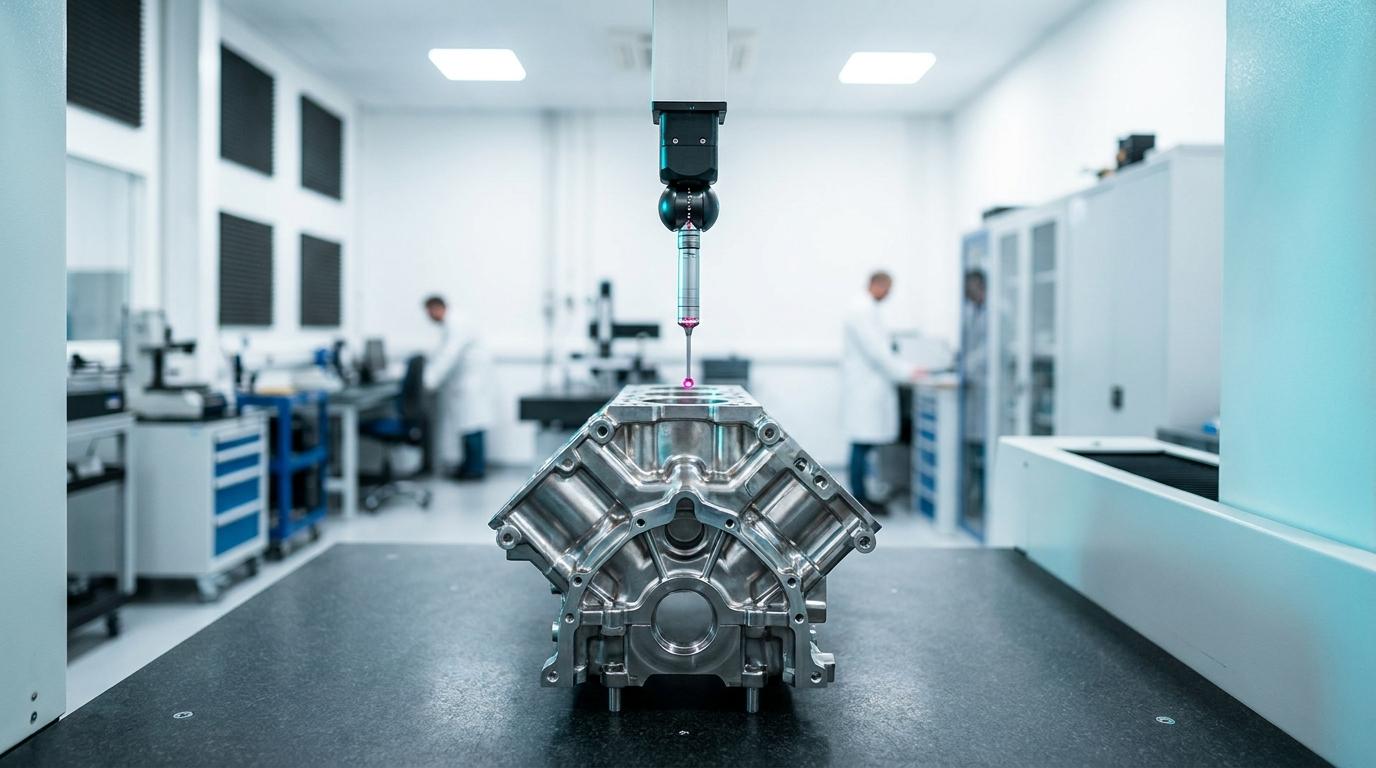
PPAP stands for Production Part Approval Process. It is the standardized method a supplier uses to prove to a customer that its production process can make a part that meets every engineering and specification requirement, repeatably, at the full production rate. A PPAP submission is a package of up to 18 required elements governed by the AIAG PPAP 4th Edition, and it is required whenever a part is new or a design, process, material, or source changes. The customer sets a submission level from 1 to 5, and Level 3, which sends the full supporting data plus the Part Submission Warrant, is the default for a new part.
Quick reference:
- What it is: documented proof that a production process makes conforming parts, standardized by AIAG for the automotive supply chain and adopted in aerospace and medical device manufacturing as well
- The 18 elements: run from Design Records (Element 1) through the Part Submission Warrant (Element 18)
- When it is required: new part, design change, process change, material change, source change, or a lapse in production (often 12 months or more)
- Submission levels: Level 1 (warrant only) through Level 5 (full data reviewed on site); Level 3 is the default for most new parts
- Element 11 capability: initial process studies report Ppk, minimum 1.67 for most characteristics, on at least 25 subgroups and 100 individual measurements
Building a PPAP package? The Package module structures all 18 elements with AI gap analysis and cross-document validation before you submit. 30-day trial, no credit card required.
If you've worked in automotive or manufacturing quality, you've heard the acronym. You've probably lived through the submission crunch, chased down missing documents at midnight, and wondered why a process designed to ensure quality so often feels like organized chaos. This guide cuts through the noise and gives you everything you need to understand PPAP, what it is, what it requires, when it's triggered, where teams go wrong, and how AI is starting to change the game.
What is PPAP?
PPAP stands for Production Part Approval Process. It's a standardized quality framework used primarily in the automotive supply chain, but increasingly adopted in aerospace, medical devices, and other high-stakes manufacturing sectors.
At its core, PPAP is a structured way for a supplier to prove to a customer that their production process can consistently produce a part that meets all engineering and specification requirements. It's not just about submitting paperwork. PPAP is a systematic demonstration that your process is in control, your measurements are reliable, and your parts are built to print, every time.
The PPAP process is governed by the AIAG (Automotive Industry Action Group) and is currently in its 4th edition. It's closely tied to other AIAG standards including APQP (Advanced Product Quality Planning), FMEA (Failure Mode and Effects Analysis), and the Control Plan.
Why does PPAP exist?
Before PPAP, every OEM had its own supplier qualification process. The result was a fragmented, inefficient mess, suppliers maintaining dozens of different documentation packages for different customers. PPAP standardized this across the automotive industry, giving both suppliers and customers a common language for production readiness.
For the quality engineer on the floor, PPAP answers one essential question: Is this process ready to make good parts at production rates?
If you would rather see a package than read about one, we built a submission-ready PPAP live in 30 minutes, through to the branded PDF cover, the signed PSW, and the share link the customer opens. Watch the replay. Free, no signup.
What are the 18 elements of PPAP?
PPAP is organized into 18 required elements. Each one addresses a specific aspect of product or process readiness. Not every element is required for every submission, the level of submission determines what's included, but understanding all 18 is non-negotiable for any quality professional.
1. Design Records
The complete, current engineering drawing for the part. This includes all specifications, tolerances, notes, and revision levels. If the customer owns the design, they supply this. If you're the design-responsible supplier, you own it.
2. Engineering Change Documents
Any authorized engineering change (ECR/ECN) that has been incorporated into the part but not yet reflected in the formal design record. Deviations must be documented and traceable.
3. Customer Engineering Approval
Written confirmation from the customer's engineering team that the part design meets their intent, especially critical for changes made prior to formal print updates.
4. Design FMEA (DFMEA)
A failure mode and effects analysis focused on the design itself. Required only when the supplier is design-responsible. This document identifies potential failure modes at the design stage and their risk mitigation.
5. Process Flow Diagram
A visual map of every step in the manufacturing process, from incoming material through shipping. It should match your Control Plan and PFMEA. If these three documents don't align, that's a red flag.
6. Process FMEA (PFMEA)
The process-level FMEA identifies how manufacturing steps can fail, their effects, and what controls are in place to prevent or detect those failures. The Risk Priority Number (RPN), or in AIAG-VDA FMEA, the Action Priority (AP), drives corrective action prioritization.
7. Control Plan
The living document that defines how each characteristic is controlled during production. It references inspection methods, frequencies, reaction plans, and responsible parties. If your operators can't find the Control Plan or it hasn't been updated since 2019, you have a problem.
8. Measurement System Analysis (MSA)
Gauge R&R and other MSA studies that demonstrate your measurement systems are capable and consistent. A part you can't reliably measure is a part you can't control. MSA is often underdone, rushed studies, ignored crossed designs, acceptable-but-marginal %GR&R values treated as passing without investigation.
9. Dimensional Results
Actual measurements taken from a defined sample of production-intent parts. Every characteristic on the print must be ballooned and measured. Results are documented in a dimensional results report, typically showing actual values against nominal and tolerance.
10. Records of Material / Performance Test Results
Test reports and material certifications confirming the part meets all functional, material, and performance requirements specified on the drawing or in the engineering specification.
11. Initial Process Study (Statistical Data)
Cpk and Ppk data for all critical and significant characteristics. The AIAG PPAP manual requires a minimum Ppk of 1.67 for new submissions. Characteristics with Ppk below 1.33 typically require a corrective action plan before approval.
12. Qualified Laboratory Documentation
Proof that all testing was performed by a qualified lab, either accredited (ISO/IEC 17025) or customer-approved. Test data from an unqualified source is not acceptable.
13. Appearance Approval Report (AAR)
Required when the part has appearance-related specifications (color, gloss, texture, grain). The AAR is signed off by the customer's styling or appearance team.
14. Sample Production Parts
Physical samples from the production run. The customer may request tagged, labeled samples for their incoming quality records. These must come from the same lot as your dimensional and statistical data.
15. Master Sample
A retained sample, signed and dated by customer and supplier, that serves as the reference standard for future production and incoming inspection.
16. Checking Aids
Fixtures, gauges, templates, or other tools used to inspect the part. These need to be documented, calibrated, and capable.
17. Customer-Specific Requirements
Any requirements beyond the core AIAG PPAP standard mandated by the specific customer. GM, Ford, Stellantis, BMW, every OEM has their own supplemental requirements.
18. Part Submission Warrant (PSW)
The cover document for the entire PPAP package. The PSW summarizes the part information, submission level, quantity produced, deviation requests, and sign-off from the supplier's authorized quality representative. Get the PSW wrong, wrong revision, wrong submission level, missing signature, and the whole package can be rejected on arrival.
What are the PPAP submission levels?
Not every submission requires all 18 elements. PPAP defines five submission levels:
| Level | What's Submitted |
|---|---|
| 1 | PSW only (warrant retained by supplier) |
| 2 | PSW + limited supporting data |
| 3 | PSW + full supporting data (most common) |
| 4 | PSW + other requirements defined by customer |
| 5 | PSW + full data reviewed at supplier's facility |
Level 3 is the default for most new part submissions. Your customer specifies the required level, confirm this before you start building your package, not after.
When is PPAP Required?
PPAP is triggered by change, not just new programs. Knowing the triggers prevents the painful surprise of a customer requesting a PPAP you didn't know you owed them.
PPAP is typically required when:
- New part or program launch: Any new part number entering production.
- Design change: Changes to the engineering drawing, specifications, or materials.
- Process change: New equipment, new tooling, new manufacturing location, new subcontractor for a critical operation.
- After a production interruption: If production stops for an extended period (often defined as 12 months or more).
- Material change: Switching to a new raw material supplier, alloy, or grade.
- Correction of discrepancy: Some customers require PPAP after significant quality escapes or corrective actions.
The safest approach: when in doubt, ask the customer. A proactive call to your SQE costs nothing. An unauthorized change that escapes into production can cost you the program.
What are the most common PPAP mistakes?
Misaligned Documents
Your Process Flow, PFMEA, and Control Plan must tell the same story. Reviewers check alignment. Disconnects signal that your quality system is paper-based, not real.
Inadequate Sample Size for Statistical Studies
Running Cpk on 10 pieces isn't an initial process study, it's a guess. AIAG requires a minimum of 25 subgroups with at least 100 total parts for a meaningful process capability study.
Outdated or Missing Calibration Records
Calibration certificates that expired six months ago attached to a current PPAP package will get you rejected. Build a calibration tracking system and pull certificates fresh for each submission.
PSW Errors
Wrong part revision, wrong customer name, wrong submission level, unsigned, PSW errors are embarrassingly common and completely avoidable. Create a PSW checklist and have a second set of eyes review it before submission.
Treating PPAP as a One-Time Event
PPAP isn't done when the part is approved. The Control Plan is a living document. Process changes must be assessed against PPAP triggers. Teams that file the PPAP and forget it are accumulating risk with every undocumented deviation.
Ignoring Customer-Specific Requirements
A Level 3 AIAG PPAP that ignores GM's CSR is a non-compliant submission. Read the CSRs for every customer. Don't assume all customers want the same thing.
How is AI changing PPAP?
The PPAP process is document-intensive, deadline-driven, and error-prone by nature. That's exactly where AI delivers measurable value.
Automated Document Generation
AI tools can pull from your existing data, print dimensions, PFMEA outputs, process parameters, and auto-populate PPAP documents. Instead of manually transferring 200 balloon dimensions from a drawing into a dimensional results template, an AI-assisted system can extract, map, and flag discrepancies in minutes.
Intelligent Cross-Document Alignment Checks
One of the highest-value applications is automated alignment verification across the Process Flow, PFMEA, and Control Plan. AI can parse all three documents, identify where process steps are missing from one or more documents, and surface gaps before the customer does.
Real-Time Submission Tracking
Modern AI-powered platforms give PPAP coordinators a live dashboard of submission status, outstanding elements, and upcoming due dates, across multiple programs simultaneously.
Predictive Risk Flagging
AI can analyze historical PPAP data to flag submissions at risk of rejection -- based on incomplete elements, marginal Ppk values, or patterns from prior submissions with the same customer.
Smarter Corrective Action Loops
When a PPAP is rejected, AI can help identify root cause by cross-referencing the rejection comments against the submission package and suggesting corrective actions based on historical patterns.
The goal isn't to replace the quality engineer, it's to eliminate the administrative burden that keeps quality engineers from doing actual quality work.
The Bottom Line
PPAP is not bureaucracy for its own sake. Done right, it's a rigorous, systematic proof that your manufacturing process is capable, controlled, and ready to deliver. The teams that treat PPAP as a checkbox exercise are the ones sending corrected submissions at 2 AM. The teams that treat it as a genuine process verification tool are the ones launching programs on time with fewer quality escapes.
Master the 18 elements. Know your triggers. Build your documents to align. And use every tool available to make the process faster and more reliable, including AI.
Ready to Streamline Your PPAP Process?
QualityEngineer.ai is built for quality engineers who are tired of managing PPAP in spreadsheets and shared drives. Automated document workflows, real-time submission tracking, cross-document alignment checks, and AI-assisted PPAP preparation, all in one platform designed specifically for manufacturing quality teams.
Start your 30-day trial at app.qualityengineer.ai, no credit card required →
No sales call required. No implementation consultant. Just log in and start building better PPAPs.