AS9102 Form 1 Part Number Accountability: The Cover Sheet That Locks the FAI Binder and How Rev C Rewrote It
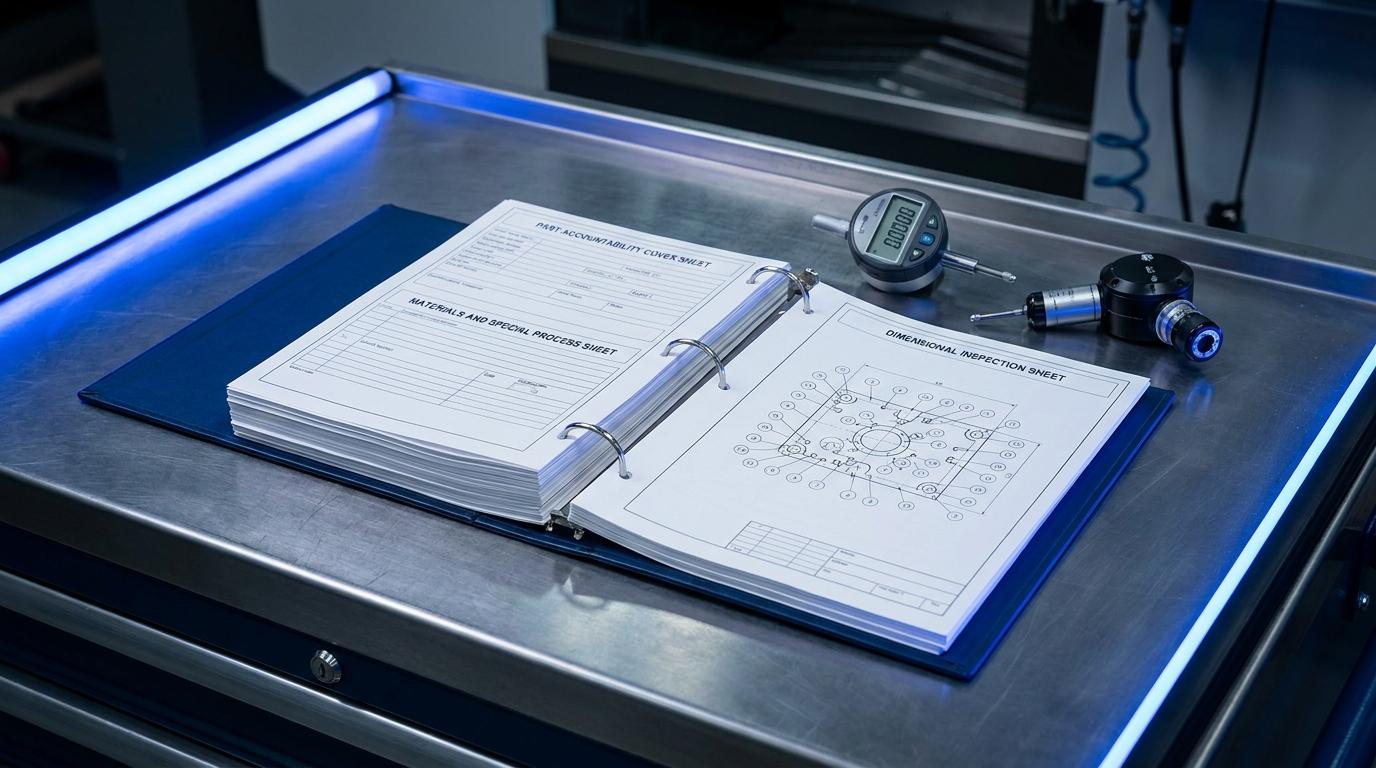
A supplier quality engineer at a Tier 1 aerospace prime opens the FAI binder on Monday morning. The part in front of her is a machined titanium bracket, twelve balloons on the drawing, a moderate BOM, one outsourced anodize, one heat treat. She turns to Form 1 and stops on line 17. The template still reads Part Serial Number. The supplier has typed the actual serial into the field. There is no Part Type value anywhere on the sheet. Field 8 has a drawing revision that does not match the design record header, and the signature block is empty because the inspector signed Form 3 first and never came back. She has not read a single dimension yet, and Form 1 has already told her three things about this supplier. The FAI template is on Rev B. The reviewer has not been trained on Rev C. And the binder was assembled out of order. She writes the kickback ticket before opening Form 2.
Form 1 is the smallest sheet in the AS9102 package. It is also the one that determines whether the reviewer trusts the rest of the binder. A clean Form 1 signals a supplier that runs the current standard and controls its own FAI process. A Rev B era Form 1 signals a supplier whose templates have not been touched in two years. That signal costs credibility on every downstream field.
This post walks Form 1 from a reviewer's seat under AS9102 Rev C. What each field carries, what changed from Rev B, how the Part Type field replaced the serial number and why, how signature lock closes the FAI, how sub-assembly rollup works when the top level FAI covers a build of two hundred piece parts, when to declare a Full FAI versus a Partial FAI and what has to be true for either declaration to stand, the four kickback patterns that account for most Form 1 rework, and a pre-submission QA pass a supplier quality lead can run in twenty minutes before the binder ships.
For the seat one FAI orientation across all three forms, Form 1, Form 2, and Form 3 fit together as a single record under Rev C. For the Form 2 deep dive on materials, special processes, and functional testing evidence, Form 2 product accountability walks the supply chain map. For the Form 3 deep dive on characteristic accountability and drawing balloon reconciliation, characteristic accountability in AS9102 covers ballooning and Form 3 one to one mapping.
Where Form 1 Sits in AS9102 Rev C
AS9102 Rev C, the active revision of the IAQG First Article Inspection standard, was published by SAE International on 2023-06-23. It structures the FAI record around three forms bound by a shared Part Number Accountability record on Form 1, a shared Product Accountability record on Form 2, and a shared Characteristic Accountability record on Form 3. Rev C supersedes Rev B (2014-10-15). Any FAI supplier still shipping Rev B templates in mid 2026 is running templates that are now two full years behind the standard.
Form 1 is the identification and scope surface for the entire FAI binder. Every downstream form references the Form 1 record. Form 2 lines cite the Form 1 Part Number, the Form 1 Drawing Number, the Form 1 Drawing Revision, and the Form 1 FAI Report Number. Form 3 balloons reference the same. When a reviewer walks the binder in sequence, Form 1 is the primary key. If Form 1 does not match the design record header, every line on Form 2 and Form 3 is suspect.
Form 1 also carries the FAI scope declaration. It states whether the FAI is a Full FAI or a Partial FAI, and if Partial, what the trigger was (design change, process change, source change, location change, tooling change, numerical control program change, or lapse in production of two years or per customer flow-down). The scope declaration governs which Form 3 rows are required and which Form 2 rows are required. Full FAI expects complete Form 3 coverage of every drawing balloon and complete Form 2 coverage of every material, process, and functional test. Partial FAI limits the required Form 3 rows to the characteristics affected by the trigger and the required Form 2 rows to the materials, processes, or tests affected by the trigger.
The reviewer walks Form 1 before Form 2 and Form 3 for a reason. Form 1 tells the reviewer what to expect on Forms 2 and 3. A Form 1 that declares Partial FAI with an unclear trigger, or a Form 1 that declares Full FAI on a part that has only had a tooling change since the last FAI, is a Form 1 that misaligns scope with evidence. The reviewer will call the kickback on Form 1 before reading further.
What Form 1 Has to Carry Under AS9102 Rev C
The AS9102 Rev C Form 1 annex defines the required field set. The count depends on how you group the sub-assembly fields, but the field list runs roughly twenty two identifiable data points across four sections: Part Identification, Design Record, Sub-assembly Accountability, and Signature and Report Metadata. Each field has a specific purpose, and each has a specific failure mode.
Part Identification
Fields 1 through 4 identify the part itself.
-
Part Number (Field 1). The customer released part number exactly as it appears on the design record. Not the supplier's internal part number, not a shortened form, not a stripped prefix. If the design record header reads P/N 145A4372 07, then Form 1 Field 1 reads P/N 145A4372 07. A reviewer cross checks this against the drawing title block.
-
Part Name (Field 2). The full part name from the drawing title block, matching case and punctuation to the design record.
-
Serialization Type (Field 3, when applicable). Serial number, lot code, batch number, or none. Rev C moved the actual serial number identifier out of the fixed Part Serial Number field and into whichever field the FAI record uses to carry the traceability identifier. Suppliers who serialize per part enter the serial in the serialization traceability field. Suppliers who batch enter the lot or batch code. Suppliers who ship non serialized commodity items enter none, and the reviewer knows the traceability is at the CofC level.
-
FAIR Identifier (Field 4). The FAI Report identifier the supplier uses internally to track this specific FAI. This is what appears in the supplier's QMS, on the CofC binder tab, and on any partial re-accomplishment references. If a partial FAI comes back to this same part in eighteen months, the partial FAI Form 1 will cite this FAIR identifier as the baseline.
Design Record
Fields 5 through 10 anchor the FAI to a specific design revision and a specific production event.
-
Design Record / Drawing Number (Field 5). The drawing number from the design record header. If the design record is a model based definition (MBD) package rather than a 2D drawing, the model identifier goes here.
-
Design Record Revision (Field 6). The revision letter or number as released by the design authority. Not the supplier's internal working copy revision. If the design authority has released Rev G and the supplier is working from a marked up Rev G draft, the FAI is against Rev G. If the supplier is working from a Rev F copy because the Rev G change order has not been signed off yet, the FAI cannot ship. This is the single most common Field 6 finding: the FAI cites Rev G, the shop floor is producing to Rev F, and the marked up drawing in the traveler is Rev F with red line changes. The reviewer catches it in five minutes.
-
Additional Changes (Field 7). Any change references (ECOs, ECNs, red line changes) incorporated between the released revision and the FAI. Rev C is explicit that if the FAI is against a design record revision plus one or more pending change notices, the FAI has to enumerate them here and Form 3 has to close every characteristic affected by each change.
-
Manufacturing Process Reference (Field 8). The supplier's internal routing, work order, or manufacturing plan identifier. This is the reviewer's traceability anchor from FAI back to shop floor. If Field 8 references a routing that no longer exists in the QMS, the FAI is orphaned.
-
Organization Name (Field 9). The supplier legal entity name. Not the supplier's brand name, not the parent holding company. The name on the AS9100 certificate.
-
Supplier Code (Field 10). The customer assigned supplier code. Every prime issues these differently. Boeing supplier codes look nothing like Lockheed Martin supplier codes. If the supplier ships to multiple primes, the FAI Field 10 is the code of the customer receiving this FAI.
Sub-assembly Accountability
Fields 11 through 15 handle the case where the top level FAI covers a build with sub-assemblies. Every BOM line that is a part in its own right gets a sub-assembly row.
-
Sub-assembly Part Number (Field 11). The part number of each sub-assembly on the BOM.
-
Sub-assembly Part Name (Field 12). The name of each sub-assembly.
-
Sub-assembly Serialization Type (Field 13). Serial number, lot, batch, or none for each sub-assembly.
-
Sub-assembly FAIR Identifier (Field 14). The FAI Report identifier of the sub-assembly's own FAI record. Rev C is unambiguous: if a sub-assembly is a part that requires its own FAI (per the same triggers that apply to the top level), that sub-assembly FAI has to be complete and referenced here. A top level FAI cannot claim coverage for a sub-assembly that does not have its own FAI record.
-
FAI Complete or Partial (Field 15). Whether the referenced sub-assembly FAI is a Full or Partial. Rev C added this column to make clear that a partial sub-assembly FAI at a lower level does not carry through as full coverage at the top level.
The sub-assembly accountability section is where most large assemblies fail. A landing gear top level FAI with sixty piece parts on the BOM has to have sixty sub-assembly rows on Form 1, each pointing to the sub-assembly's own FAI record. If ten of those rows point to FAIs that were done to Rev B, or point to FAIs that were completed but not signed on Form 1, the top level FAI is not defensible.
Signature and Report Metadata
Fields 16 through 22 close the record.
-
Part Type (Field 17 under Rev C, replacing the old Part Serial Number field). One of five values: detail part, sub-assembly, software, standard catalog item, or COTS (commercial off the shelf). This is the most visible Rev C change from Rev B. The IAQG made the change because Form 1 needed to classify every BOM item and the old serial number field was not pulling that weight on assemblies. A Rev B template that still reads Part Serial Number in this field is a two second Rev B tell.
-
Full FAI or Partial FAI (Field 18). The scope declaration. Full FAI is required for a new part, a first production run, or after a two year lapse. Partial FAI is required for a design change, process change, source change, location change, tooling change, or numerical control program change. The trigger has to be one of the AS9102 Clause 4 triggers. Partial FAI on a discretionary "we felt like it" basis is not a valid declaration.
-
Reason for Partial FAI (Field 19). The specific trigger. Rev C examples include design change (with the ECO or ECN cited), process change (with the process step cited), and source change (with the new source cited). "Rework" is not a valid Field 19 entry. A rework is not an FAI trigger. Rework goes through a separate NCR and disposition record.
-
Baseline Part Number Including Revision (Field 20). For a Partial FAI, the part number and revision of the baseline FAI this partial is against. This is how the reviewer knows the partial FAI is legitimately partial. A partial FAI without a baseline reference is a full FAI with fields missing.
-
FAI Complete or Not Complete (Field 21). A binary sign off. Complete means every required Form 2 row and every required Form 3 row (per the Full or Partial scope on Field 18) has been fully populated with evidence and signed. Not Complete triggers a Non Conformance Report per AS9102 Rev C.
-
Signature Block (Field 22). Name, signature, date, and organization of the person accountable for the FAI. This is the field that Rev C uses to close the record. Under Rev B, Form 2 and Form 3 carried their own signature blocks. Under Rev C, Form 1 is the only signature surface. When the responsible signer signs Form 1, the act locks Form 2 and Form 3 as part of the same FAI record. Signing Form 1 before Form 2 or Form 3 is complete is a red flag that the FAI process is out of order.
The Three Rev C Changes That Redefined Form 1
Rev C is not a superficial revision. Three specific changes materially alter how Form 1 is filled out, and the field on the sheet where each of them lives is a Rev B versus Rev C tell any reviewer picks up in under a minute.
Change 1: Part Type Replaces Part Serial Number in Field 17
Rev B Field 17 was Part Serial Number. Rev C Field 17 is Part Type, taking one of five values (detail, sub-assembly, software, standard catalog item, or COTS). The actual serial number, when one exists, moves to the serialization traceability field (Field 3). This looks cosmetic. It is not. The change makes Form 1 into a BOM classification tool that a reviewer uses to know whether every line on the BOM is accounted for. A Rev B era Form 1 does not tell the reviewer whether an item on the BOM is a COTS or a detail, so the reviewer cannot verify that COTS items got the Rev C required Form 2 row. Under Rev C, the Part Type is on the face of Form 1, and the reviewer can walk the classification in seconds.
Kickback pattern: supplier uses a Rev B template. Field 17 reads a serial number. There is no Part Type anywhere on the sheet. The reviewer flags the entire FAI as Rev B non conformant and asks for a Rev C resubmission.
Change 2: COTS and Standard Catalog Items Now Get Form 1 Rows
Under Rev B, suppliers disagreed about whether COTS bolts, washers, and standard catalog items required Form 1 entries. Some teams listed only the build to print details. Rev C is unambiguous. Every item on the BOM that is part of the delivered assembly gets a Form 1 line, whether it is a detail part, a sub-assembly, a software item, a standard catalog item, or a COTS item. If a MS16997 socket head cap screw is on the BOM, it is on Form 1. If a Loctite 271 threadlocker is on the BOM, it is on Form 1. If a paint pigment is called out on the BOM under an approved supplier flow-down, it is on Form 1.
Kickback pattern: supplier submits a Form 1 that lists only the machined details and the sub-assemblies. The COTS hardware is invisible. Reviewer counts BOM lines against Form 1 rows and finds a mismatch. Kickback opens against Form 1 completeness.
Change 3: Signature Lock Closes the FAI on Form 1
Under Rev B, Form 2 and Form 3 carried their own signature blocks. Inspectors signed off on each form as they were completed. This allowed a binder to be assembled in any sequence, and it allowed a Form 3 to be signed before its Form 1 was drafted, which is exactly backwards. Rev C locks Form 1 as the authoritative signature surface. Form 2 and Form 3 no longer have signature blocks in the Rev C templates. When the responsible signer signs Form 1 (Field 22), the act locks Form 2 and Form 3 as part of the same FAI record. If either Form 2 or Form 3 is not yet complete when Field 22 is signed, the FAI is signed against incomplete evidence and the reviewer treats it as a supplier quality system finding.
In practice, this means the inspector signs Form 1 last, not first. The Form 1 signature is the closing act of the FAI, not the opening act. If the template asks for a Form 3 signature at all, it is a Rev B template.
Kickback pattern: supplier ships a binder with Form 1 signed on Monday, Form 3 populated by the CMM operator on Wednesday, Form 2 finalized by the QA lead on Thursday. Reviewer notices the Form 1 signature date precedes the Form 3 completion date. Kickback opens on FAI sequence integrity.
Full FAI Versus Partial FAI: How Form 1 Field 18 Governs Everything Downstream
Field 18 declares the FAI scope. It is a two option toggle: Full FAI or Partial FAI. Every downstream requirement on Form 2 and Form 3 depends on which option is on Field 18.
Full FAI is required in four scenarios per AS9102 Clause 4. First production of a new part from a released design record. First production after a two year lapse (or a shorter lapse per customer flow-down, which most primes now specify). First production at a new manufacturing location. First production from a materially different manufacturing process, source, or tooling that in the design organization's judgment affects every characteristic.
A Full FAI declaration on Field 18 means Form 3 has to close every drawing balloon and Form 2 has to close every material, special process, and functional test on the design record. There is no partial coverage lane. The binder covers everything.
Partial FAI is required in the change scenarios that do not rise to a full re-accomplishment. A design change that affects some characteristics but not others. A process change that affects some steps but not others. A source change on one special process but not others. A tooling rebuild that affects some features but not others. A numerical control program change that affects some balloons but not others.
A Partial FAI declaration on Field 18 has to be accompanied by a specific trigger on Field 19 and a specific baseline reference on Field 20. Form 3 rows are limited to the characteristics affected by the change, and every affected characteristic has to be closed. Form 2 rows are limited to the materials, special processes, or functional tests affected by the change, and every affected item has to be closed. Everything not in scope of the change is inherited from the baseline FAI referenced on Field 20.
For a walkthrough of when partial FAI is required and what has to be in the binder, see when you need a partial FAI re-accomplishment and what has to be in the binder.
The Field 18 declaration is where reviewers spend the second most time on Form 1, after the design record cross check on Field 6. A Partial FAI declared on a part that in the reviewer's judgment should be a Full FAI is a kickback. A Full FAI declared on a part that has only had a minor tooling change since the last FAI is a red flag that the supplier is overproducing FAI evidence to hide something.
The Four Kickback Patterns on Form 1
Across a couple hundred aerospace FAI reviews, the Form 1 kickbacks cluster into four repeatable patterns. Every supplier quality lead who has been in the seat has seen all four.
Pattern 1: Design Record Revision Mismatch
Field 5 cites Drawing 145A4372 07, Field 6 cites Rev G, and the design record header at the customer's design authority reads Rev H as of the FAI ship date. This happens when the customer released a revision that the supplier's design distribution has not caught up to, or when the supplier's document control has a Rev H change notice sitting in the inbox and the FAI was drafted before the notice was processed. The kickback is on Form 1 Field 6 and it invalidates every Form 3 row because the drawing balloon count and the balloon locations have shifted between revisions.
The fix is a document control gate before the FAI is drafted. The supplier's QMS has to confirm the drawing revision against the customer's design authority release list on the day the FAI Form 1 is signed. If the release list shows a newer revision, the FAI does not ship until the supplier evaluates whether the newer revision impacts characteristics already inspected.
Pattern 2: Sub-assembly FAI Missing or Incomplete
Field 14 references a sub-assembly FAI Report identifier that the supplier's QMS shows as In Process, or references a FAIR identifier that does not exist in the QMS at all. This happens when the top level FAI is drafted before every sub-assembly FAI is closed, either because the top level owner assumed the sub-assembly owners were done or because a piece part FAI was verbally reported complete but never signed.
The fix is a sub-assembly FAI status board maintained by the top level FAI owner. Before Form 1 Field 22 is signed, every Field 14 reference has to point to a sub-assembly FAI record with a signed Form 1 in the QMS. A top level FAI whose sub-assemblies are not fully closed is not a top level FAI. It is a status report.
Pattern 3: COTS and Standard Catalog Items Not on Form 1
Every fastener on the BOM, every washer, every threadlocker, every commercial finish paint. Under Rev C, each is a Form 1 line with Part Type set to COTS or Standard Catalog Item. Suppliers who trained on Rev B still leave these off, or list them in a separate BOM tab and skip the Form 1 lines. Reviewers count BOM lines and count Form 1 lines. A mismatch is an immediate kickback on Form 1 completeness.
The fix is a Form 1 template that pulls Form 1 lines directly from the released BOM. If the BOM has forty seven lines, Form 1 has forty seven lines. If the BOM adds a line in a change notice, Form 1 adds a line. The template has to enforce the one to one.
Pattern 4: Signature Sequence Out of Order
Form 1 Field 22 is signed on Monday, Form 3 balloons are still being measured on Wednesday, Form 2 special process certs arrive on Thursday. The Form 1 signature date precedes the Form 3 completion date, which under Rev C signals that the responsible signer closed the FAI against incomplete evidence.
The fix is a workflow discipline in the QMS. Form 1 Field 22 does not become signable until Form 2 is complete and Form 3 is complete. Any FAI package that lets Form 1 be signed early violates the Rev C sequence integrity requirement, and any reviewer who catches the discrepancy will treat it as a quality system finding, not just a document error.
The 20 Minute Pre-submission QA Pass for Form 1
A supplier quality lead can run this Form 1 QA pass in about twenty minutes. It catches the four patterns above and most of the smaller Form 1 gaps before the binder leaves the shop.
-
Design record cross check (three minutes). Pull the current design record release list from the customer's design authority. Confirm the drawing number on Form 1 Field 5 matches the release list, and the revision on Form 1 Field 6 is the current released revision as of the FAI ship date. If Field 7 lists any Additional Changes, cross check each ECO or ECN against the release list.
-
BOM to Form 1 line count (two minutes). Open the released BOM. Count the lines. Open Form 1. Count the top level part plus the sub-assembly rows plus any COTS and standard catalog rows. The two counts must match exactly. If the BOM has forty seven lines, Form 1 has forty seven lines.
-
Part Type walk (three minutes). For each Form 1 line, confirm Field 17 Part Type is populated with one of the five valid values (detail, sub-assembly, software, standard catalog item, or COTS). A blank Field 17 or a Rev B era serial number in Field 17 is a Rev B tell that has to be fixed before ship.
-
Sub-assembly FAI reference walk (five minutes). For each Field 14 sub-assembly FAIR identifier, open the referenced sub-assembly FAI record in the QMS. Confirm the sub-assembly Form 1 is signed. Confirm the sub-assembly Field 18 Full or Partial matches what Form 1 Field 15 claims. Any In Process sub-assembly FAI holds the top level FAI.
-
Scope declaration integrity (three minutes). Read Form 1 Field 18. If Full FAI, confirm the trigger is one of the AS9102 Clause 4 Full triggers (new part, two year lapse, new location, materially different process). If Partial FAI, confirm Field 19 cites a specific AS9102 Clause 4 Partial trigger and Field 20 cites a specific baseline FAI. Confirm Form 3 row count and Form 2 row count match the scope: Full FAI expects complete coverage, Partial FAI expects coverage limited to the trigger.
-
Signature sequence check (two minutes). Confirm Form 2 is complete and Form 3 is complete before Form 1 Field 22 is signed. Compare Field 22 signature date against the Form 3 completion date and the Form 2 cert dates. Field 22 must be the latest of the three. If not, the FAI is out of sequence and has to be re-signed after Form 2 and Form 3 are finalized.
-
Supplier and customer identity fields (two minutes). Confirm Field 9 Organization Name matches the AS9100 certificate. Confirm Field 10 Supplier Code matches the customer's supplier code for the receiving prime. A wrong Field 10 sends the FAI to the wrong customer inbox and buys a week of tracing.
If any step fails, the FAI does not ship. The twenty minutes at the end are cheap. A partial re-accomplishment forced by a Form 1 kickback is not.
How Form 1 Ties Into the AS9100D Evidence Package
Form 1 is not a standalone record. It is a node in a larger AS9100D evidence graph that reviewers walk when they are evaluating supplier maturity, not just this specific FAI.
The clauses that surface Form 1 evidence in a Stage 2 audit are Clause 8.5.1.3 (verification of validation activities), Clause 8.4.3 (control of externally provided processes for the sub-assembly FAI references), Clause 8.1.1 (operational planning and control for the FAI process itself), and Clause 8.3.4.4 (design and development controls for the design record revision cross check). A supplier whose Form 1 records consistently cite the wrong design record revision is signaling weakness under Clause 8.3.4.4. A supplier whose sub-assembly FAI references are consistently incomplete is signaling weakness under Clause 8.4.3. A supplier whose signature sequences are out of order is signaling weakness under Clause 8.1.1.
For the full clause by clause auditor view of AS9100 evidence patterns, see what objective evidence each AS9100 requirement wants before the CB walks in. For the AS9100 audit checklist framing that ties Form 1 evidence into the broader aerospace audit, see what aerospace quality teams need to cover in an AS9100 internal audit.
Form 1 also cross references PPAP for suppliers who ship to both aerospace and automotive customers. The AS9102 FAI record does not substitute for a PPAP submission, and the PPAP submission does not substitute for an FAI. For the comparison of when a supplier needs FAI, PPAP, or both, see FAI vs PPAP for aerospace suppliers. For the PPAP element by element checklist that the customer reviewer expects to see on the automotive side, see what each of the 18 PPAP elements has to show to pass a customer submission review.
Where QualityEngineer.ai Fits Into the Form 1 Workflow
The Form 1 QA pass above is a manual discipline. It works because a supplier quality lead has been trained on it and runs it every time. It fails when the lead is under load, when the FAI volume spikes, or when a new inspector is running their first FAI without oversight. The failure modes are exactly the four kickback patterns above, and they are exactly the patterns that a purpose built FAI tool can prevent at authoring time rather than catch at review time.
The Package module generates AS9102 Rev C compliant Form 1 records with the field level validation the Rev C annex requires. Part Type on Field 17 is a required dropdown with the five valid values. COTS and standard catalog items pull directly from the released BOM and cannot be omitted. Sub-assembly FAI references validate against the QMS in real time, and a Form 1 with an In Process sub-assembly reference cannot be signed. Design record revision cross checks against the customer design authority release list on the day of signature. Signature sequence enforcement prevents Form 1 Field 22 from being signed until Form 2 and Form 3 are complete. The Rev C template lives in the product, so a supplier who is still shipping Rev B templates on their own paper does not have that failure mode when they ship on QualityEngineer.ai.
The Blueprint Intelligence module upstreams the Form 3 balloon extraction so the Form 3 characteristic count matches the drawing balloon count on the day the design record was released, and it flags any drawing revision mismatch between the extracted feature set and the released revision the FAI is against. That closes the design record revision mismatch kickback at authoring time.
The Supplier Quality module carries the supplier code, the AS9100 certificate reference, and the customer flow-down references so Field 9 and Field 10 populate consistently across FAIs and never mis route to the wrong customer.
The Form 1 discipline is not exotic. The Rev C standard has been public for two years, and every field on Form 1 is one that a trained inspector has seen a hundred times. The failure mode is not knowledge. It is the volume of manual QA the twenty minute pre-submission pass represents on every single FAI, on every single revision, across every sub-assembly. Tooling that enforces the Rev C annex at authoring time is the difference between an FAI package that lands clean the first time and an FAI package that comes back on Friday with the reviewer's ticket already open.
Bottom Line
Form 1 is the smallest sheet in an AS9102 Rev C FAI binder and the one that sets the reviewer's read on everything downstream. Twenty two fields across four sections, three material Rev C changes (Part Type replacing the serial number in Field 17, COTS and standard catalog items now requiring Form 1 lines, and Form 1 as the signature lock that closes Form 2 and Form 3), and one scope declaration on Field 18 that governs which Form 2 and Form 3 rows are required. The four kickback patterns, design record revision mismatch on Field 6, sub-assembly FAI missing on Field 14, COTS and standard catalog items not on Form 1, and signature sequence out of order on Field 22, account for most of the Form 1 rework in aerospace supply chains. Each is fixable by a discipline that lives at authoring time, not at review time.
The twenty minute pre-submission QA pass is the manual version of the fix. A purpose built FAI tool is the systematic version. Either way, a Form 1 that closes clean is the difference between a binder that lands on the first read and a binder that comes back with a partial FAI re-accomplishment forced by a Field 6 revision mismatch that the supplier could have caught in three minutes.
For the seat one FAI orientation across all three forms, Form 1, Form 2, and Form 3 fit together as a single record under AS9102 Rev C. For the Form 2 deep dive on the materials, special processes, and functional testing evidence, Form 2 product accountability walks the supply chain map. For the Form 3 deep dive on characteristic accountability and drawing balloon reconciliation, characteristic accountability in AS9102 covers ballooning and Form 3 one to one mapping. For the trigger logic that drives partial FAI when a Form 1 field changes between binders, AS9102 partial FAI re-accomplishment walks when and why. For aerospace suppliers also running PPAP on the same parts, FAI vs PPAP walks the reconciliation. For the audit clauses that sit behind Form 1 in an AS9100 system, AS9100 clause by clause audit readiness walks the objective evidence a certification body expects.