AS9102 First Article Inspection: How Form 1, Form 2, and Form 3 Fit Together Under Rev C
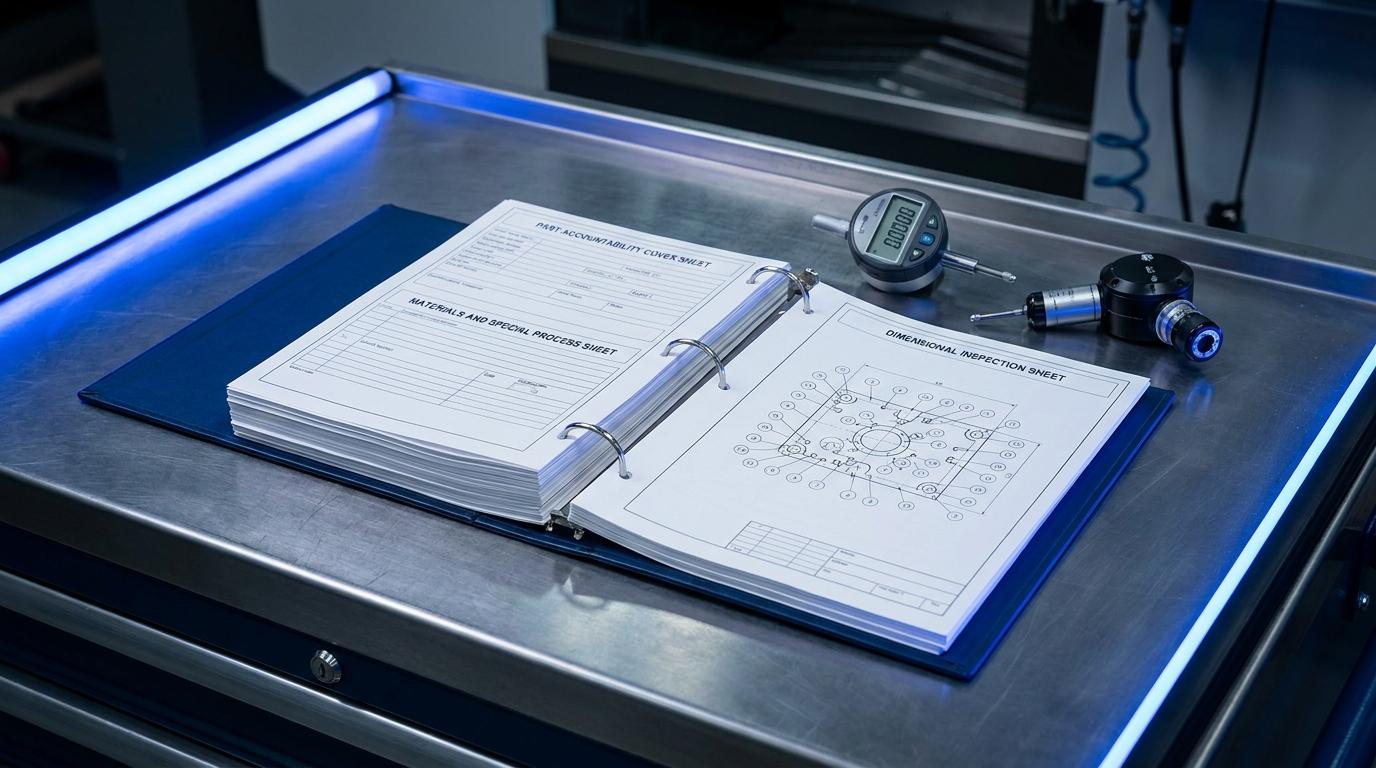
AS9102 First Article Inspection uses three forms that together document that a production process makes a conforming part. Form 1 is part number accountability: it identifies the part, ties the FAI to a drawing revision and a production lot, and lists every item on the bill of materials. Form 2 is material and process verification: raw material specifications, special processes such as heat treat and anodize, standard catalog items, and functional testing, each with objective evidence. Form 3 is the dimensional results: every ballooned characteristic on the drawing with its requirement, actual measured value, and measurement method. The current revision is AS9102 Rev C, dated 2023-06-23, and an FAI is required for a new part, an engineering change, a process or location change, or a lapse in production of two years.
Quick reference (AS9102 Rev C):
- Form 1: part accountability, one line per BOM item including COTS and standard catalog items, closed by the signature that locks the FAI record
- Form 2: material specs, special processes (Nadcap or approved source), catalog items, and functional tests, each pointing to a named certificate or record
- Form 3: one row per ballooned characteristic, with actual value and measurement method, GD&T counted as one characteristic per feature control frame
- Rev C signature lock: signing Form 1 locks Forms 2 and 3; Form 2 and Form 3 no longer carry their own signature blocks. See where the drawing-to-Form-1 chain actually breaks for the six places a binder gets rejected before it ever reaches this signature.
- When required: new part, engineering change affecting fit, form, or function, process or source change, or a two-year production lapse
Running an FAI binder? The Build module generates the FAI document set, and Blueprint Intelligence extracts the characteristics for Form 3 straight from the drawing. 30-day trial, no credit card required.
A new aerospace customer accepts your quote on Friday. The drawing is at Rev D, the BOM has fourteen items, two of those items are COTS hardware, one is a standard catalog item, and the customer flow-down clause says "First Article Inspection per AS9102, latest revision, prior to first delivery." Your shop has done AS9102 work before, but the previous binder was built against Rev B and the inspector who ran that program retired in 2024. The question is whether your team can produce an FAI package today that an aerospace SQE will accept on the first read.
That binder is governed by AS9102 Rev C, published by SAE and the IAQG on 2023-06-23. Rev C has been the current revision for about two years now. If your FAI templates still reference Rev B, the part numbering on Form 1 will look subtly wrong, the signature lock behavior will be different from what your inspector expects, and the COTS coverage will be incomplete. None of those are individually catastrophic, but together they signal to a Stage 2 auditor that your team is not running the current standard.
This guide walks through the three forms, when an FAI is required, how Form 1 changed under Rev C, what re-accomplishment really means, and how the AS9102 record fits into the larger AS9100D evidence package.
What is an AS9102 FAI?
An AS9102 First Article Inspection is the documented verification that the production process produces a part that conforms to every requirement on the design record. It is not the prototype review. It is not a one-off measurement check. It is the formal proof, captured on three standard forms, that the production tooling, the production routing, the production operator, and the production inspection method together deliver a conforming part.
AS9102 is owned by the International Aerospace Quality Group (IAQG) and published by SAE International as a standard. The current revision is Rev C, dated 2023-06-23. It supersedes Rev B (dated 2014-10-15) and Rev A (2004-11). Aerospace customers reference it by its base number, "AS9102," and rely on the supplier to use the current revision. Citing the standard without a revision letter is acceptable on a quality manual. Building a template that hard-codes "Rev B" is not.
The standard is short. The body is roughly forty pages and the forms are appended as Annex A (Form 1), Annex B (Form 2), and Annex C (Form 3). The forms are not optional. AS9102 mandates the three-form structure. You can format them inside your own QMS, in spreadsheet, or in software, but the field content has to map one-to-one to the published annex. A custom format that drops fields or relabels them is a finding.
We recorded a live session taking a drawing through feature extraction and ballooning to an inspector-ready FAI form, with measurements entered in the inspector portal and exported for the customer. Watch the replay. Free, no signup.
When is an AS9102 FAI required?
AS9102 Clause 4 defines the triggers for a first article. There are four broad triggers, and aerospace SQEs spend more time arguing about partial FAI re-accomplishment than about any other clause in the standard.
| Trigger | What it means |
|---|---|
| New part | First time the part is produced from a released design record. |
| Engineering change | Any design change affecting fit, form, or function as recognized by the design organization. |
| Process or location change | A change in the manufacturing process, manufacturing source, tooling, location, or numerical control program that can affect fit, form, function, or quality. |
| Lapse in production | A lapse in production of two years or as specified by the customer. |
The clause that confuses people is the third one. A move from one CNC mill to a different CNC mill of the same make and model in the same facility might not require a full FAI, but it almost certainly requires a partial FAI on the characteristics affected by the move. A tooling rebuild, a new fixture, a different vendor for an outsourced heat treat, a change from one ITAR-cleared subcontractor to another: each of these can trigger a partial FAI on the affected characteristics, and the supplier is responsible for the impact analysis.
The two-year lapse trigger is enforced more loosely than it should be. If a part has not been produced in two years, the documented assumption is that the process has drifted, the operator memory is gone, and a fresh FAI is the safest path. Customers may flow down a shorter lapse window. Read the contract.
A partial FAI is the same three-form structure but with content limited to the characteristics affected by the change. Form 3 lists only the changed characteristics. Form 2 lists only the materials or processes that changed. Form 1 is always fully completed because it carries the part accountability fields that have to be re-signed regardless of scope.
What goes on AS9102 Form 1 (part number accountability)?
Form 1 is the cover sheet of the FAI binder. It identifies the part, ties the FAI to a specific drawing revision and a specific production lot, and accounts for every item on the bill of materials. It is also where the most visible Rev C change lives.
Under Rev B, Field 17 was labeled Part Serial Number. Under Rev C, Field 17 is labeled Part Type, and the supplier picks one of five values: detail, sub-assembly, software, standard catalog item, or COTS. The serial number, when one exists, moves to a different field. This is not a cosmetic rename. The IAQG made the change because Form 1 needed to carry classification of every BOM line and the old serial-number field was not pulling that weight on assemblies.
The Rev C clarification on COTS coverage is the other big shift. Under Rev B, suppliers disagreed about whether commercial-off-the-shelf items required a Form 1 entry. Some teams listed only the build-to-print details. Rev C is unambiguous: every item on the BOM that is part of the delivered assembly gets a line on Form 1, including detail parts, sub-assemblies, standard catalog items, and COTS. If a bolt or a washer is part of the assembly, it is on Form 1.
A complete Form 1 entry per BOM line covers the part number, the name, the drawing number with revision, the part type, the lot or batch number traceable to production, the AS9102 form references for sub-assembly FAIs (when applicable), and the signature block. The signature block is where Rev C adds the third significant change.
Signature lock under Rev C
In Rev B, Form 2 and Form 3 carried their own signature blocks. Inspectors signed off on each form as they were completed, which felt right but allowed the binder to be assembled out of order, with a Form 3 signed before its underlying Form 1 was even drafted. Rev C addresses this by locking Form 1 as the authoritative signature surface. When the responsible signer signs Form 1, the act locks Forms 2 and 3 as part of the same FAI record. Signature blocks on Form 2 and Form 3 are no longer captured or displayed in the Rev C templates.
In practice this means the inspector signs Form 1 last, not first. The Form 1 signature is the act that closes the FAI. If you find a template that still asks for Form 2 and Form 3 signatures separately, that template is on Rev B.
What goes on AS9102 Form 2 (material and process verification)?
Form 2 covers everything that is not a dimensional characteristic. Material specifications, special processes, standard catalog items, and any required functional testing all live on Form 2. The form is structured as a table of requirements, each row referencing the source on the drawing or specification, the requirement itself, and the objective evidence that the requirement was met.
Material rows reference the raw material specification (for example AMS 4117 for an aluminum bar), the heat or lot number, and the certificate of conformance from the mill. The Form 2 entry does not transcribe the certificate; it points to it. The certificate goes in the FAI binder as supporting evidence, usually as a PDF attachment in modern packages.
Process rows are where suppliers most often lose points in an FAI review. A drawing that calls out anodize per MIL-A-8625 Type II Class 2 needs a Form 2 row that names the special process, names the Nadcap-accredited (or otherwise approved) processor, references the Certificate of Conformance for that process, and ties the lot back to the production lot on Form 1. If the anodize is outsourced, the FAI binder includes the subcontractor's certificate. If the subcontractor changes between FAIs, that is a partial FAI trigger on the affected processes.
Standard catalog items and COTS each get a Form 2 row that references the supplier, the catalog number, and either the manufacturer's CofC or a receiving inspection record. The Rev C clarification on Form 1 (every BOM item gets a row) carries through to Form 2: every special process and every catalog item in the BOM is documented.
A common Form 2 finding is a vague "verified per QC procedure 4.7" entry with no document number, no revision, no record reference. Auditors want the evidence trail to terminate in a specific artifact, not in a procedure. Name the certificate, name the inspection record, name the lot.
What goes on AS9102 Form 3 (dimensional inspection results)?
Form 3 is the dimensional report. Every characteristic on the drawing, the model, and any associated specifications gets a line on Form 3. The line carries the characteristic number (ballooned on the drawing), the requirement (nominal plus tolerance), the actual measured value, the measurement method or gauge, the inspector, and a pass/fail determination.
This is where the surface-finish-per-balloon principle from the Surface Finish Per Balloon post matters. A surface finish callout (Ra, lay, machining allowance) is a characteristic. It gets a balloon, a row on Form 3, an actual measurement, and a measurement method. Treating surface finish as a note instead of a characteristic produces a Form 3 with the wrong row count and an auditor with a hypothesis about the rest of the binder.
Form 3 rows for GD&T characteristics carry the same accountability. A position tolerance with two datum references is one characteristic on Form 3, not three. The actual is the measured position deviation, the method names the CMM program or the manual inspection setup, and the pass/fail respects the modifier (MMC, RFS, projected tolerance zone). Aerospace SQEs read GD&T rows carefully because position-and-form errors are the most common cause of FAI rework.
For software and electrical characteristics that do not lend themselves to a single measured value, Form 3 still requires a row, but the actual references a test report or a functional test record. The principle is the same: every requirement has a row, every row has objective evidence, every piece of evidence terminates in a named artifact.
When Form 3 gets long
A complex machined part can have several hundred dimensional characteristics on the drawing. A 400-row Form 3 is normal for aerospace work. The pain is not the inspector measuring 400 characteristics; the pain is balloon-to-Form-3 transcription. Every balloon on the drawing has to map to a row on Form 3, and every row on Form 3 has to map back to a balloon. A missing balloon or a duplicated row turns into a finding.
This is where automated Blueprint Intelligence extraction earns its keep. Reading 400 characteristics off a PDF by hand, ballooning them in Visio or Bluebeam, transcribing them into an Excel template, and then re-checking the count against the inspector's report is twelve hours of work that the platform can do in an afternoon with a human in the loop for the GD&T calls.
What changed between AS9102 Rev B and Rev C?
The substantive differences for an aerospace SQE to memorize are five.
- Form 1 Field 17 changed from Part Serial Number to Part Type, with five allowed values (detail, sub-assembly, software, standard catalog item, COTS).
- COTS and standard catalog items are explicitly in scope. Every BOM line goes on Form 1 regardless of whether it is build-to-print or off-the-shelf.
- Signature locking on Form 1 locks Forms 2 and 3 as part of the same FAI record. Signature blocks on Form 2 and Form 3 are no longer captured or displayed.
- FAI planning, evaluation, and re-accomplishment language is tightened to align with AS9100D wording on configuration management and verification.
- Stronger emphasis on partial FAI scoping. The standard is more explicit about which characteristics require re-verification when a process changes, and the supplier is on the hook to document the impact analysis.
Templates that hard-code Rev B field labels will fail a Rev C audit. Templates that say "AS9102 latest revision" and pull the field labels from a current source will not.
How does an FAI fit into the AS9100D evidence package?
An FAI is not a freestanding deliverable. It plugs into the AS9100D evidence trail that the certification body inspects during surveillance. The relevant clauses are 8.5.1 (control of production), 8.6 (release of products), and the configuration management requirements in 8.5.2.
A complete FAI binder typically includes:
- Form 1, Form 2, Form 3 with the Form 1 signature closing the record
- The released drawing at the revision called out on Form 1
- The ballooned drawing showing every characteristic and matching the Form 3 row count
- Material certificates for each raw material lot, traceable to the Form 1 lot
- Special process certificates (Nadcap or equivalent) for each outsourced process
- COTS and standard catalog item CofCs or receiving inspection records
- Functional test reports for any required tests
- Inspection records, gauge calibration records, and CMM program references
The binder is the artifact the auditor opens during a Stage 2 visit. The auditor will pick a random part, ask for its FAI, and walk the trail from the Form 1 signature back to a material lot and an outsourced process certificate. The trail has to be intact and the dates have to be in order. Missing certificates and date inversions (a CofC dated after the FAI signature) are the two most common findings.
The FAI binder also feeds the PPAP submission when an aerospace customer requires both. PPAP Element 8 (Initial Sample Inspection Report) maps closely to AS9102 Form 3, and many aerospace customers accept a complete AS9102 package in place of the PPAP dimensional element. The two are not interchangeable everywhere, but the dimensional content overlaps almost completely.
For internal auditing, the AS9100 Internal Audit Checklist walks the rest of the AS9100D clause structure that surrounds the FAI evidence trail. The two posts are designed to be read together.
How do you run a Rev C FAI without burning a week?
The fastest aerospace FAI cycles share a few habits.
Balloon the drawing as part of the engineering release, not at the start of the FAI. Balloons are part of the design record. If the design organization releases the drawing already ballooned, the FAI team is not transcribing under deadline pressure.
Treat Form 2 as a checklist driven by the BOM. Every BOM line generates a Form 2 row. Every special process callout generates a Form 2 row. Build the rows from the BOM and the drawing notes, then fill in the evidence.
Capture the measurement method per row on Form 3. "CMM" is not a method. "CMM program FAI-12345 rev 2 on the Zeiss Contura, last calibrated 2026-03-14" is a method. Auditors look at the method column.
Close the FAI with the Form 1 signature only. Under Rev C, the Form 1 signature is the act of acceptance. Train inspectors to sign Form 1 last, not first.
Re-accomplish on a process change without waiting to be asked. When a tooling rebuild or a subcontractor change happens, schedule the partial FAI as part of the change record. Customers notice when a supplier surfaces a partial FAI proactively. They also notice when the partial FAI surfaces six months late as part of a corrective action.
A Rev C-conformant FAI binder for a moderately complex part should take a day and a half of focused work after the production lot is complete. If your team is consistently running three or four days, the bottleneck is almost always Form 3 transcription, which is exactly the part of the process that automated ballooning and characteristic extraction solves.
Related Reading
- AS9100 Internal Audit Checklist for the broader AS9100D clause structure that surrounds the FAI evidence trail
- Surface Finish Per Balloon for why surface finish callouts belong on Form 3, not in the notes column
- What is PPAP? for how AS9102 Form 3 maps to PPAP Element 8 on dual-submission programs